

Sensitivity Analysis
For a parameterised initial-value problem
the forward sensitivity is the matrix of partial derivatives of the trajectory with respect to the parameters,
Knowing — not just at one time but as a trajectory — is the foundation of parameter estimation, optimal experimental design, gradient-based calibration, and uncertainty quantification along an ODE solution. Numra computes it via the simultaneous-corrector augmented-system formulation as documented in CVODES; the rest of this page documents the math, the API, the result layout, and the performance characteristics.
Why solve for alongside the state?
Section titled “Why solve for S(t) alongside the state?”The naive alternative is to take finite differences of the solution: solve the ODE at and at , and approximate by their difference quotient. This is sometimes called external sensitivity — and it works, sometimes. But it has three persistent problems on real workloads:
- Cost scales as full integrations of the original system. Each one is independent and starts from scratch.
- Truncation error and round-off compete. A central FD with step has truncation but round-off from cancellation; the optimum depends on the parameter scale and is hard to pick a priori.
- Step-control coupling. The two solves at and make different adaptive step decisions. The difference quotient then conflates parameter sensitivity with step-size noise. At tight tolerances this can completely dominate.
The forward-sensitivity approach instead augments the state: it solves and together as a single ODE of dimension . One adaptive controller, one tolerance bag, one set of step decisions — and analytical Jacobians can be supplied where they materially change cost.
The sensitivity equation
Section titled “The sensitivity equation”Differentiating the IVP with respect to and exchanging the order of differentiation gives the per-parameter sensitivity column
Stacking all columns produces the augmented system
with augmented Jacobian
dropping the second-derivative coupling. This is the
simultaneous-corrector form (CVODES CV_SIMULTANEOUS) — the
augmented Jacobian factorises as identical
blocks, and on stiff problems implicit solvers can in principle reuse
a single LU of across all blocks.
v1 of Numra’s solvers does dense LU on the full augmented matrix;
block-aware factorisation is a tracked follow-up.
Initial sensitivity
Section titled “Initial sensitivity”If does not depend on — the most common case — then
and the augmented initial state is simply
. This is what AugmentedSystem::initial_augmented
returns by default.
When does depend on (for example, the initial value
is one of the parameters being calibrated), override
ParametricOdeSystem::initial_sensitivity:
fn initial_sensitivity(&self, _y0: &[f64], s0: &mut [f64]) { // y_0 = p, so ∂y_0/∂p = 1 (column-major: s0[k * N + j]). s0[0] = 1.0;}The regression test nontrivial_initial_sensitivity in
numra-ode/tests/sensitivity_regression.rs pins this case for
dy/dt = -k y, y(0) = p and checks that the recovered
matches the analytical .
Quick start: closure form
Section titled “Quick start: closure form”The fastest entry point is solve_forward_sensitivity_with, which
takes a closure of shape :
use numra::ode::{DoPri5, SolverOptions};use numra::sensitivity::solve_forward_sensitivity_with;
// dy/dt = -k y, y(0) = 1, k = 0.5.// Analytical: y(t) = exp(-k t),  ∂y/∂k(t) = -t·exp(-k t).let r = solve_forward_sensitivity_with::<DoPri5, f64, _>(    |_t, y, p, dy| { dy[0] = -p[0] * y[0]; },    &[1.0],     // y0    &[0.5],     // params    0.0, 5.0,   // [t0, tf]    &SolverOptions::default().rtol(1e-10).atol(1e-12),).unwrap();
let last = r.len() - 1;let dy_dk = r.dyi_dpj(last, 0, 0);  // ∂y_0(t_final)/∂k_0let analytical = -r.t[last] * (-0.5 * r.t[last]).exp();assert!((dy_dk - analytical).abs() < 1e-7);
The closure form uses forward finite differences for both Jacobians (the trait-default behaviour). For non-stiff problems and small parameter counts, this is plenty. Move to the trait form when you need analytical Jacobians, multi-call reuse, or tight stiff performance.
The ParametricOdeSystem trait
Section titled “The ParametricOdeSystem trait”The full power lives in the trait. A minimal implementation supplies four methods; everything else is defaulted:
use numra::ode::ParametricOdeSystem;
struct Decay { k: f64 }
impl ParametricOdeSystem<f64> for Decay {    fn n_states(&self) -> usize { 1 }    fn n_params(&self) -> usize { 1 }    fn params(&self)   -> &[f64] { std::slice::from_ref(&self.k) }    fn rhs_with_params(&self, _t: f64, y: &[f64], p: &[f64], dy: &mut [f64]) {        dy[0] = -p[0] * y[0];    }}
rhs_with_params is the primitive form: it accepts an arbitrary
parameter vector rather than reading from self. This is what
lets the trait-default Jacobians perturb for FD without mutating
self — and what lets AugmentedSystem reuse Jacobian scratch
buffers across calls without allocating.
Default forward FD
Section titled “Default forward FD”When you don’t override jacobian_y or jacobian_p, Numra falls back
to forward finite differences with step
(or respectively). On f64 that’s about .
Forward FD costs extra RHS evaluations per Jacobian call;
the augmented integrator caches scratch buffers across calls so the
per-call allocation is one-shot.
Analytical Jacobians
Section titled “Analytical Jacobians”For stiff problems where Jacobians appear inside Newton iteration, analytical overrides are usually a 10–30% wall-clock win and a much larger win on Jacobian-evaluation count. The trait expects two specific layouts:
| Method | Shape | Layout |
|---|---|---|
jacobian_y | row-major: jy[i * N + j] = ∂f_i/∂y_j | |
jacobian_p | column-major: jp[k * N + i] = ∂f_i/∂p_k |
The asymmetry is deliberate: jacobian_p’s column-major layout lets
AugmentedSystem slice off as a contiguous vector when
assembling the per-parameter sensitivity column — no
gather-from-strided needed. jacobian_y’s row-major layout matches
the convention used elsewhere in numra-ode for explicit-solver
Jacobians.
The has_analytical_jacobian_* flag contract
Section titled “The has_analytical_jacobian_* flag contract”Overriding jacobian_y (or jacobian_p) is not by itself enough
to make AugmentedSystem use it. The trait also has two flag methods,
has_analytical_jacobian_y and has_analytical_jacobian_p, that
default to false. When the flag is false, the augmented hot path
inlines its own forward FD with reused scratch buffers — bypassing the
override entirely.
If you override the method, also override the flag:
impl ParametricOdeSystem<f64> for Decay { // ... rhs_with_params, n_states, n_params, params ... fn jacobian_y(&self, _t: f64, _y: &[f64], jy: &mut [f64]) { jy[0] = -self.k; } fn jacobian_p(&self, _t: f64, y: &[f64], jp: &mut [f64]) { jp[0] = -y[0]; } fn has_analytical_jacobian_y(&self) -> bool { true } fn has_analytical_jacobian_p(&self) -> bool { true }}This is the same pattern as CVODES’s set_jacobian_user_supplied —
it lets the augmented hot path skip FD scratch allocation for the
common FD-default case while still respecting analytical overrides
when they’re worth wiring up.
Solving and reading the result
Section titled “Solving and reading the result”Two entry points, depending on how your system is shaped:
| Function | Takes | Returns | Use when |
|---|---|---|---|
solve_forward_sensitivity | &Sys: ParametricOdeSystem | SensitivityResult<S> | You have a struct with analytical Jacobians, multi-call reuse, or non-trivial state. |
solve_forward_sensitivity_with | A closure | SensitivityResult<S> | You want a quick one-shot call without a struct boilerplate. |
Both are generic over the choice of solver:
use numra::ode::{Bdf, DoPri5, Radau5, SolverOptions, Tsit5};use numra::solve_forward_sensitivity;
let opts = SolverOptions::default().rtol(1e-8).atol(1e-10);
// Pick the solver via turbofish:let r = solve_forward_sensitivity::<Radau5, f64, _>(&system, 0.0, 40.0, &y0, &opts)?;let r = solve_forward_sensitivity::<Bdf,    f64, _>(&system, 0.0, 40.0, &y0, &opts)?;let r = solve_forward_sensitivity::<DoPri5, f64, _>(&system, 0.0, 40.0, &y0, &opts)?;
Result layout
Section titled “Result layout”SensitivityResult<S> is a flat-vec result deliberately shaped for
zero-copy slicing. The state is row-major over time:
y[i * N + j] = y_j(t_i). The sensitivity is row-major over time and
column-major over parameters within each per-time block:
The asymmetry is intentional: per-parameter columns
are contiguous slices, so sensitivity_for_param
returns a &[f64] of length without any indexing dance. This
matches CVODES indexing conventions.
Accessor surface
Section titled “Accessor surface”Reach for the typed accessors instead of indexing the flat Vec
directly. They’re unit-tested, layout-agnostic from the caller’s view,
and forward-compatible if the underlying flattening ever changes.
| Accessor | Returns | Meaning |
|---|---|---|
r.len() | usize | Number of output time points. |
r.t[i] | S | Time . |
r.y_at(i) | &[S] (length ) | State vector at . |
r.sensitivity_at(i) | &[S] (length ) | Full sensitivity block at , column-major. |
r.sensitivity_for_param(i, k) | &[S] (length ) | Contiguous at . |
r.dyi_dpj(i, state, param) | S | Single component . |
r.final_state() | &[S] | Convenience: y_at(len() - 1). |
r.final_sensitivity() | &[S] | Convenience: sensitivity_at(len() - 1). |
r.normalized_sensitivity_at(i, p_nominal) | Vec<S> | — dimensionless. |
r.success, r.message, r.stats | — | Solver outcome and Criterion-style stats (n_eval, n_jac, n_accept, n_reject, n_lu). |
The normalised sensitivity is the version you usually want when ranking parameters whose magnitudes span orders of magnitude — see the Robertson example below for a worked case.
Worked example: Robertson stiff kinetics
Section titled “Worked example: Robertson stiff kinetics”The Robertson chemical kinetics system is the canonical stiff benchmark: three states, three rate constants spanning eight orders of magnitude, mass conservation .
The complete worked example lives at
numra/examples/robertson_sensitivity.rs;
run it with
cargo run --release --example robertson_sensitivity -p numraThe example walks through implementing ParametricOdeSystem with
analytical Jacobians, calling solve_forward_sensitivity::<Radau5, _, _>,
and reading the result via the full accessor surface. The most
interesting block is the influence ranking:
Normalised sensitivity (k_k / y_j) · (∂y_j/∂k_k):                    k1             k2             k3  y0 normalised =     -2.3735e-1     -9.5904e-2      1.9182e-1  y1 normalised =      1.9993e-1     -3.7169e-1     -2.5662e-1  y2 normalised =      5.9790e-1      2.4160e-1     -4.8319e-1
Influence ranking (largest |normalised sensitivity| first):  y0: k1 (2.37e-1) > k3 (1.92e-1) > k2 (9.59e-2)  y1: k2 (3.72e-1) > k3 (2.57e-1) > k1 (2.00e-1)  y2: k1 (5.98e-1) > k3 (4.83e-1) > k2 (2.42e-1)
Note how the ranking is different per state. The slow consumption of A (state ) is dominated by ; the catalyst concentration B () is dominated by the self-reaction; the cumulative product C () is also -dominated because it inherits the slow A → B funnel. A single global ranking would miss all three of these.
The output also passes two internal sanity checks:
- State mass conservation: to twelve digits.
- Sensitivity-mass conservation: for each — a direct consequence of state mass conservation. If the integrator drifted, this sum would too; that it stays at zero is good evidence the augmented integration is consistent.
Choosing a solver
Section titled “Choosing a solver”The same problem run through different solvers can have radically different wall-clock costs once the augmented system is in play. The Robertson bench plotted below makes the point:
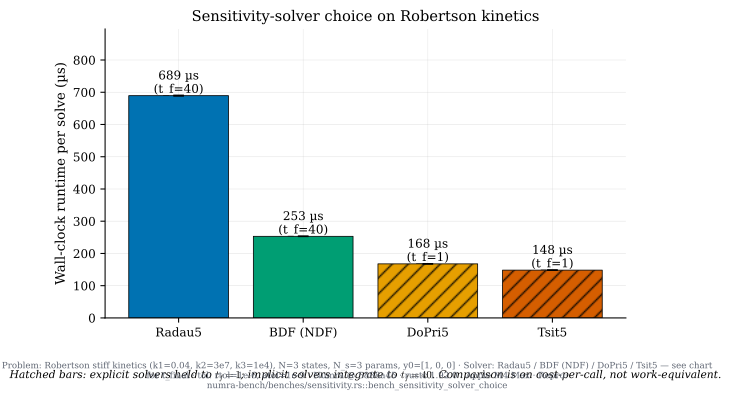
The takeaway: for stiff problems, use an implicit solver — Radau5 or BDF. The bar chart’s hatched bars (DoPri5, Tsit5) only integrate to , not ; comparing them to the implicit bars at face value would be misleading, which is why the chart annotates the asymmetry. On the same problem extended to , the explicit solvers would either fail outright or take orders of magnitude longer.
The general guidance:
| Problem class | First choice | Backup |
|---|---|---|
| Non-stiff, smooth | DoPri5 or Tsit5 | Vern6/7/8/9 at very tight tolerances |
| Mildly stiff | ESDIRK54 | Radau5 |
| Severely stiff (rate constants spanning decades) | Radau5 | BDF (NDF / ode15s-style) |
| DAE (index ≤ 1) | Radau5 | BDF |
If you don’t want to pick explicitly, the
Auto
solver type applies the same heuristics — pass it as the solver
type parameter to solve_forward_sensitivity exactly like any
concrete solver:
use numra::ode::{Auto, SolverOptions};use numra::solve_forward_sensitivity;
let r = solve_forward_sensitivity::<Auto, f64, _>(&system, t0, tf, &y0, &opts)?;
Auto performs lightweight stiffness detection on the augmented
system’s RHS and routes to Tsit5/Esdirk54/BDF or Radau5 accordingly.
Sensitivity equations inherit the state’s stiffness exactly, so the
auto-selection that’s right for the bare state is also right for
the augmented system in nearly all cases. The standalone
auto_solve
convenience function operates on a plain OdeSystem and returns
SolverResult<S>, not SensitivityResult<S> — use the Auto
type-parameter form above when you want auto-selection inside the
sensitivity pipeline.
Performance
Section titled “Performance”Two charts pin down the cost structure of the forward-sensitivity
integration. All measurements use the publication-grade 20s/3s
Criterion windows; the underlying bench harness lives at
numra-bench/benches/sensitivity.rs
and the Criterion-flattened JSON is committed at
numra-bench/results/sensitivity_*.json
so the SVGs can be regenerated on a different machine without
re-running the benches.
Cost vs parameter count
Section titled “Cost vs parameter count”The augmented system has dimension , so naive theory says wall-clock should grow about linearly in . What we actually see is sub-linear because the per-step overhead (adaptive step decisions, tolerance checks, function-call dispatch) amortises across the augmented state:
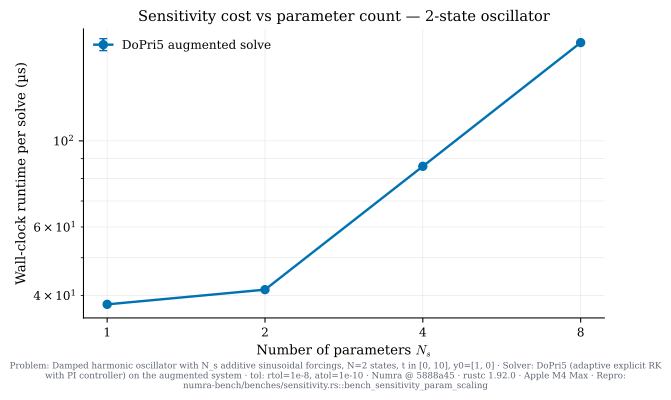
The sub-linear scaling is one reason the simultaneous-corrector
formulation is the right baseline. With staggered correction (CVODES
CV_STAGGERED / CV_STAGGERED1) you’d recover linear scaling at the
cost of additional Newton iterations per step; both variants are
tracked as named follow-ups for stiff workloads where the trade-off
flips.
Analytical vs FD Jacobians
Section titled “Analytical vs FD Jacobians”For implicit solvers driving a stiff augmented system, Jacobian quality shows up directly in the inner Newton loop:
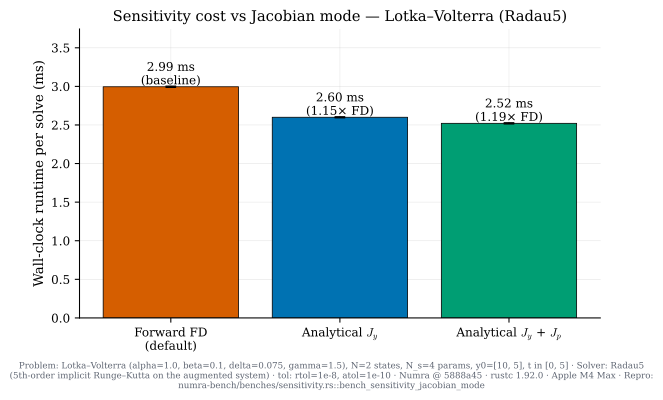
Going from FD to fully analytical gives about a 19% wall-clock speedup on this problem (3.0 ms → 2.5 ms). The bulk of the win comes from — the parameter Jacobian is only used in the forcing term of the sensitivity equation, not inside Newton’s iteration matrix, so it has a smaller marginal effect.
The win scales with stiffness: on the more aggressive Robertson problem (rate constants spanning eight decades), analytical Jacobians can give 2–3× speedups — far more than the 19% above. If you’re going to use a stiff solver for sensitivity, write the analytical Jacobians. The cost is a few extra trait methods and a unit test; the payoff is real.
Allocation policy
Section titled “Allocation policy”AugmentedSystem keeps reusable scratch buffers in RefCell<Vec<S>>
fields — one each for , , the FD perturbed state and
parameter vectors, and the FD baseline / perturbed RHS values. The
hot path borrows them mutably, never reallocates, and never reaches
back through the trait’s default FD (which would allocate per call).
This is what made the
solve_trajectory port land ~40% faster than
the previous private AugmentedOdeSystem: that version paid six
fresh Vec allocations on every RHS evaluation.
The scratch buffers are sized once at AugmentedSystem::new time
based on n_states() and n_params(). If you build a single
AugmentedSystem and call solve_forward_sensitivity on it
repeatedly with different parameter vectors, those calls share the
scratch — no per-call allocation pressure.
Edge cases and gotchas
Section titled “Edge cases and gotchas”Parameter scaling
Section titled “Parameter scaling”If your parameters span very different magnitudes — say, a rate
constant of alongside a temperature of — the raw
sensitivity matrix will have entries spanning many decades and the
adaptive controller’s atol may be biting one direction much harder
than another.
The fix is usually to work in normalised coordinates:
- Reformulate the model so all parameters are — e.g. with the new sensitivity variable.
- Or report results via
normalized_sensitivity_at, which strips the scale by dividing by and gives you a dimensionless number you can compare across parameters.
Identifiability
Section titled “Identifiability”Two parameters that always appear in a fixed combination (e.g. only as the product ) will have parallel sensitivity columns — proportional to at every . The forward-sensitivity solver doesn’t care; you’ll still get clean trajectories. But your downstream estimator will choke: the Fisher information matrix becomes rank-deficient, and any gradient-based fit will see infinitely many equivalent parameter combinations.
A quick check: compute the sensitivity matrix at several time points, stack them into a matrix, and look at its condition number or rank. If two columns are nearly parallel, your parameters are not jointly identifiable — and no amount of better data will fix it without a structural change to the model.
Tolerance inheritance
Section titled “Tolerance inheritance”The augmented system inherits rtol and atol from SolverOptions
uniformly across the state and the sensitivity. This is the SciML
default and works well for most problems. When the sensitivity
magnitudes are very different from the state magnitudes (e.g. you’re
computing tiny sensitivities in absolute terms but the state is
), you may want separate sensitivity tolerances —
CVODES exposes CVodeSensSStolerances for this. v1 of Numra ships
without that knob; it’s tracked as a named follow-up.
Non-trivial initial conditions
Section titled “Non-trivial initial conditions”If your initial state itself depends on parameters (y_0 = y_0(p)),
the augmented IC for the sensitivity is not zero. Override
initial_sensitivity to return the correct
in column-major form. Forgetting to do this gives you correct
but systematically wrong — a silent failure mode
that’s particularly nasty in calibration workflows where the bias is
direction-consistent.
The regression test nontrivial_initial_sensitivity covers the
canonical case (y_0 = p for the simple decay system) and is a good
template for problem-specific overrides.
Closure form perf
Section titled “Closure form perf”The closure form (solve_forward_sensitivity_with) wraps your
closure in a ClosureSystem, which reports
has_analytical_jacobian_y/_p = false. That means every closure-form
solve goes through inline FD with reused scratch — there’s no way to
plug in analytical Jacobians via the closure interface. For one-shot
calls and scripts that’s fine; for a production calibration loop,
move to the trait form. The performance difference can be 30%+ on
stiff problems.
Forward vs adjoint sensitivity
Section titled “Forward vs adjoint sensitivity”Forward sensitivity is the right tool when:
- (parameter count) is small — say, .
- You need at many output times, not just one cost-functional gradient.
- You also want the trajectory as a side product (you do).
For very large (think: PDE-constrained optimisation with a
discretised control field — hundreds of thousands of parameters), the
augmented dimension blows up and forward
sensitivity becomes unaffordable. The adjoint method swaps the
linear-in- scaling for linear-in- where is the
number of cost-functional outputs — usually one. Numra exposes
adjoint gradients through numra-ocp::adjoint_gradient; see
Adjoint Methods.
The rough crossover for ODE-constrained optimisation:
| First choice | |
|---|---|
| Forward — one solve, full trajectory. | |
| Either; depends on whether you need at intermediate times. | |
| Adjoint — backward solve with state checkpointing. |
If you only need the gradient of a scalar cost — and not the full sensitivity trajectory — adjoint wins almost regardless of .
Compatibility with other Numra primitives
Section titled “Compatibility with other Numra primitives”Forward sensitivity composes cleanly with the rest of the workspace:
numra-ocp::ParamEstProblemuses forward sensitivity internally (whenOdeSolverChoice::Sensitivityis set) to compute analytical gradients for parameter estimation; see Parameter Estimation.numra-ocp::forward_sensitivityis now a thin wrapper oversolve_forward_sensitivity_with— same canonical type, same accessors, same allocation policy.numra-ode::uncertainty::solve_trajectoryinUncertaintyMode::Trajectorylikewise dispatches through the canonical primitive.
Anything that previously rolled its own augmented-system loop in the workspace has been ported over. There is one source of truth.
A note on Rust peers
Section titled “A note on Rust peers”The closest peer in the Rust ecosystem is
diffsol (Robinson et al., Journal of
Open Source Software 11(117), 2026), which implements forward and
adjoint sensitivity using a builder API with Jacobian–vector products
and Enzyme-based AD via its DiffSL DSL — better suited to large
sparse problems and matrix-free Krylov solvers. Numra’s design is
trait-based with full Jacobian matrices, suitable for small-to-medium
dense problems and aimed at making the augmented-system semantics
visible at the API surface (the column-major sensitivity layout, the
analytical-Jacobian flag contract, the debug-build safety net) rather
than abstracted behind a builder. The two libraries cover overlapping
but distinct sweet spots; the canonical reference for the
augmented-system formulation remains SUNDIALS CVODES.
Reference
Section titled “Reference”- Hindmarsh et al., SUNDIALS: Suite of Nonlinear and Differential/Algebraic Equation Solvers, ACM TOMS 31(3), 2005. Documents the simultaneous-corrector and staggered-corrector formulations.
- Serban & Hindmarsh, CVODES: An ODE Solver with Sensitivity Analysis Capabilities, Tech. Rep. UCRL-JP-200039, LLNL, 2003. Original CVODES design; Numra’s column-major sensitivity layout follows this convention.
- Hairer, Nørsett & Wanner, Solving Ordinary Differential Equations II: Stiff and Differential-Algebraic Problems, Springer, 1996. Chapter VI.6 covers sensitivity analysis from first principles for both Runge–Kutta and BDF integrators.
- Cao, Li, Petzold & Serban, Adjoint Sensitivity Analysis for Differential-Algebraic Equations: The Adjoint DAE System and Its Numerical Solution, SIAM J. Sci. Comput. 24(3), 2003. The reference for the forward-vs-adjoint trade-off.
For implementation details and all eight regression tests pinning
the v1 invariants, see
numra-ode/tests/sensitivity_regression.rs.
The full performance bench harness is at
numra-bench/benches/sensitivity.rs.