

Tolerance vs runtime
For a fixed problem, runtime is a smooth function of accuracy. As
you tighten rtol, the adaptive controller takes more, smaller steps
and the wall-clock cost rises. The interesting question is how
quickly — and that depends on the order of the embedded RK pair.
The chart
Section titled “The chart”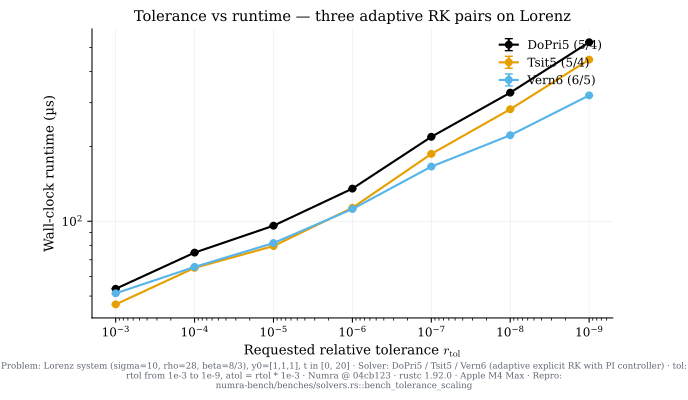
What it shows
Section titled “What it shows”- At slack tolerances (
rtol = 1e-3) the lower-order schemes (DoPri5, Tsit5) win on wall-clock — they take roughly the same number of steps as Vern6 but each step is cheaper. - At tight tolerances (
rtol = 1e-9) the higher-order Vern6 pulls ahead. A 6th-order pair needs fewer steps to hit the same accuracy, and once the per-step overhead is amortised over enough function evaluations the order advantage dominates. - The slope on a log-log plot is roughly
0.1–0.2for all three schemes — meaning a 6-decade tightening of tolerance costs about one decade of runtime. That’s the adaptive controller earning its keep.
How to read this for your problem
Section titled “How to read this for your problem”The crossover between Tsit5 and Vern6 sits between 1e-6 and 1e-7
on Lorenz. For your problem the crossover may be elsewhere:
- Smoother right-hand sides push the crossover toward looser tolerances (the higher-order scheme wins more often).
- Stiffer or oscillatory dynamics push it the other way and may push you toward an implicit solver entirely — see the stiffness-handling page.
- Very expensive RHS evaluations also favour higher-order schemes because each saved step is a saved RHS evaluation.
The Numra auto_solve heuristic uses these crossovers as defaults
when you don’t pick a solver explicitly.