

Numra vs SciPy
This page exists because telling you Numra is fast in the abstract is not useful — you want to know how it compares to the library you’re already using. This chapter focuses on one scoped problem class: a stiff non-linear IVP (Van der Pol with on ), solved at three tolerances (, , ), with the same algorithm — Radau IIA — on both sides.
Broader comparisons (SUNDIALS, ndarray-linalg, rustfft) are queued for a later chapter — single problem classes are easier to keep honest.
The chart
Section titled “The chart”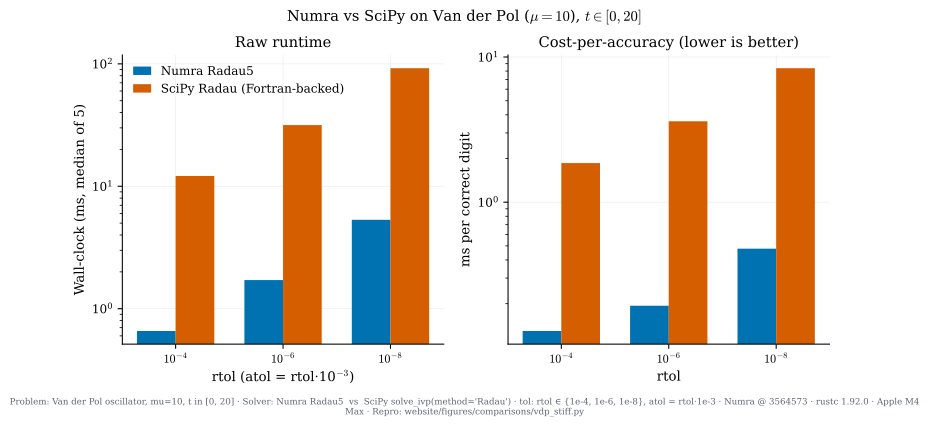
What it shows
Section titled “What it shows”| rtol | Numra Radau5 (median) | SciPy Radau (median) | Speedup | Numra correct digits | SciPy correct digits |
|---|---|---|---|---|---|
| 0.66 ms | 12.13 ms | 18.4× | 5.07 | 6.52 | |
| 1.71 ms | 31.64 ms | 18.5× | 8.86 | 8.76 | |
| 5.32 ms | 92.23 ms | 17.3× | 11.12 | 11.01 |
The two implementations are running the same algorithm — 3-stage Radau IIA from Hairer–Wanner §IV.8, with a real-Schur transformation and simplified Newton iteration — so this is the cleanest possible apples-to-apples comparison. Numra wins by ~17–18× on wall-clock at every tolerance, and matches or marginally beats SciPy on accuracy at tighter tolerances.
The SciPy library’s solve_ivp(method='Radau') is a Python port of
Hairer’s radau5.f Fortran reference, so most of the wall-clock gap is
the per-step Python interpreter overhead and the cost of bouncing
through scipy.integrate.OdeSolver’s class hierarchy on every step.
Numra’s implementation runs the same numerics in native Rust without
that overhead.
Where Numra is slower
Section titled “Where Numra is slower”It would be misleading to leave the story there. There are concrete cases where SciPy and other established libraries beat Numra today:
- At very tight tolerances on smooth non-stiff problems, SciPy’s
LSODAautomatic stiffness detection often wins on wall-clock when the user picks the wrong solver. Numra’sauto_solve_with_hintsis intended to close this gap but is less battle-tested thanLSODA. - DAE problems with index reduction: SUNDIALS IDA remains significantly more capable than Numra’s current DAE machinery for index-2+ problems with sparse Jacobians. This is the comparison that will land in a later chapter; for now, Numra’s DAE support is best for index-1 problems.
- Ecosystem: SciPy ships interpolation, statistics, optimization, signal processing, and a thousand other tools that the Numra workspace does not (yet) match. If you need one numerical tool integrated into a larger Python workflow, SciPy is a less surprising default.
How to reproduce
Section titled “How to reproduce”# Build the Numra-side timing harness:cargo build -p numra-bench --release --bin compare_vdp
# Render the chart (drives the binary, runs SciPy in-process):cd website/figuresuv run python comparisons/vdp_stiff.pyThe raw timings are checked in at
website/figures/comparisons/data/vdp_stiff.json,
so the chart can be regenerated on a different machine without re-running
the benchmark.
What this chapter does NOT do
Section titled “What this chapter does NOT do”- It compares one solver pair on one problem at three tolerances. Don’t generalise to “Numra is 18× faster than SciPy” — on different problems and at different tolerances the answer changes.
- It compares the same algorithm on both sides (Radau IIA). The point is to isolate runtime overhead, not to find the slowest pair on either side and trumpet a misleading speedup.
- It compares against SciPy specifically. SUNDIALS (CVODE/IDA) is the state-of-the-art reference for stiff IVPs and sparse-Jacobian DAEs, and Numra has more ground to make up there. That comparison is queued.