

Stiffness handling
When a problem develops sharp transitions between fast and slow dynamics, an explicit solver’s stability footprint shrinks until each step shrinks with it. An implicit solver’s per-step cost is higher — it has to factor a Jacobian and solve a Newton iteration — but its stability is unconditional, so the step size stays sane.
The chart
Section titled “The chart”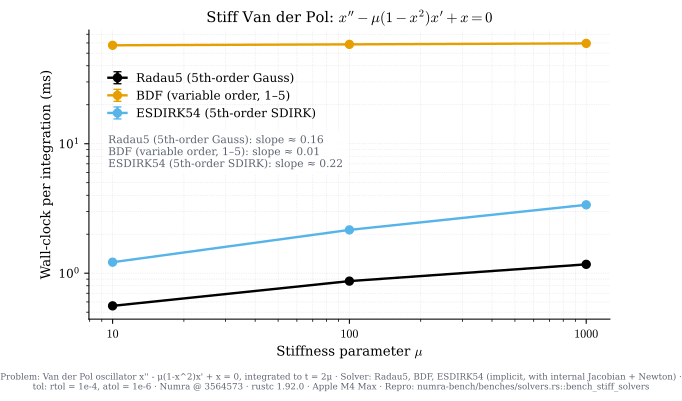
What it shows
Section titled “What it shows”- The integration interval here is
t ∈ [0, 2μ]. Asμgrows the problem gets both longer and stiffer — runtime should grow at least linearly inμpurely from interval length, plus more from step-count growth. - Radau5 dominates at every
μin the swept range. The 5th-order L-stable Radau IIA scheme combined with the rewritten step controller (Hairer–Wanner §IV.8 + Gustafsson predictive controller) takes large, well-sized strides through the slow phase and adapts cleanly through the transients. - ESDIRK54 sits a small constant factor behind Radau5. Its singly-diagonally-implicit structure lets each Newton iterate factor the same Jacobian block, which is a useful win on systems where factorisation dominates.
- BDF is roughly flat in
μhere — its per-step cost is small but the variable-order controller lingers at low order on the slow phase, so accumulated step counts dominate.
How to choose
Section titled “How to choose”The pragmatic rule of thumb:
| Stiffness scale | Recommended starting solver |
|---|---|
| Stiff IVPs and DAEs (default) | Radau5 |
| Smooth coefficients, prefer SDIRK | ESDIRK54 |
| Long-horizon, low-order acceptable | BDF |
When in doubt, use auto_solve_with_hints and pass Stiffness::High
— it will pick from the same list using these crossover points as
defaults.
What’s not in the chart
Section titled “What’s not in the chart”This bench fixes tolerances at rtol = 1e-4, atol = 1e-6. Tightening
tolerances changes the absolute numbers but not the slopes — the
ranking is robust across a couple of decades of tolerance.
For the explicit-vs-implicit crossover (when does it stop making sense to push DoPri5 through a stiff problem at all?), see the dimension-scaling page.